
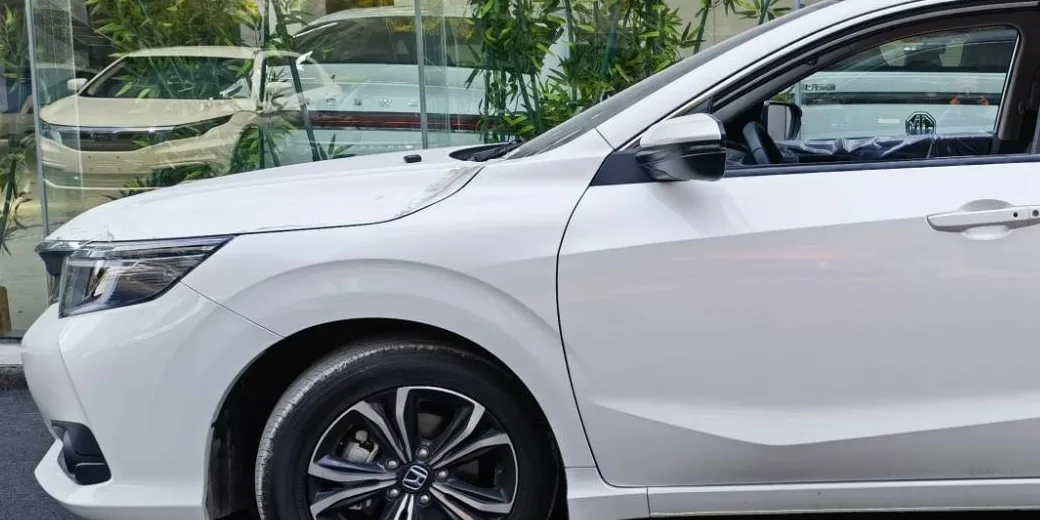
In China, a Honda Crider is an easy car to own: every GAC Honda dealer knows it and stocks its parts. Outside China it is a car the local Honda distributor never sold, so its workshop has no parts on the shelf and may not have its data in the system. That is manageable, but only if parts and service are planned before the cars land, not after the first one comes in on a tow truck.
What is shared and what is Crider-only
The mechanical heart of the car belongs to a wider family. The 1.0-litre turbo is part of Honda's P10A engine family, which in P10A2 form has powered the City sold in Thailand since 2019 and was used in the European Civic, and the Crider shares its platform with its Dongfeng Honda twin sold in China as the Envix. The body and interior are a different story.
| Part group | Where it comes from | Planning note |
|---|---|---|
| Engine service parts: filters, spark plugs, belts, sensors | Shared engine family; availability varies by region | Confirm every part number against the VIN; do not assume a similar-looking part fits |
| CVT fluid and filters | Honda specification fluid | Stock the specified fluid before the first service is due |
| Brake pads and discs | Available from China; some interchange exists | Carry a small stock; confirm fitment against the VIN |
| Bumpers, grille, lamps, body panels, glass | Crider-specific, sourced from China | The long-lead items; hold a minimum stock for collision repairs |
| Interior trim and head unit | Crider-specific, sourced from China | Order on demand, but know the lead time |
Fluids and consumables
- Engine oil: the viscosity printed in the owner's manual, to API SP or ILSAC GF-6 or later, for the reasons explained in the Crider engine guide.
- CVT fluid: Honda HCF-2, with the fluid service carried out as the manufacturer describes; background in CVT care in hot climates.
- Brake fluid: the type marked on the reservoir cap, replaced on time as well as distance.
- Coolant: the manufacturer's long-life coolant. Do not top up with a different type; mixing chemistries shortens the life of both.
- Filters: oil, air and cabin. In dusty markets the air and cabin filters are the ones that run out first.
A starting parts kit
For a first batch of about ten cars, this is a reasonable starting point, to be adjusted once you see how your customers use them:
| Item | Quantity | Why |
|---|---|---|
| Oil filters | 20 | Two services per car |
| Air filters and cabin filters | 10 each | One change per car; more in dusty markets |
| Front brake pad sets | 4 | Fastest-wearing brake item in city use |
| Rear brake pad sets | 2 | Slower wear, but an electric parking brake car should not wait for them |
| CVT fluid | Enough for three fluid services | The one fluid you cannot improvise |
| Wiper blade sets | 5 | Heat and sun age them fast |
| Front bumper cover, grille, one headlamp each side, fog lamps, mirror glass | 1 of each | The typical minor-collision parts, all Crider-specific |
| Windscreen | 1 | Long lead time and fragile to ship later; confirm the correct version for cars with a windscreen camera |
The reasoning behind stock levels for a model new to a market is covered in spare parts strategy for a new brand.
Diagnostics: generic codes are not enough
A generic OBD scanner reads emissions-related engine faults. Servicing the whole car needs make-specific coverage for these jobs:
- Electric parking brake. Rear pad replacement requires putting the parking brake into its maintenance mode with a tool or the specified procedure. Forcing the caliper piston back damages the actuator.
- CVT service. Fluid level checks and any learning procedures after service are done with the diagnostic tool on many modern CVTs.
- Tyre pressure warning. After adjusting pressures or rotating tyres, the system must be re-initialised following the owner's manual.
- Airbag, stability control and body modules. Reading and clearing their faults is outside generic OBD.
- Driver-assist sensors on Flagship versions with Honda SENSING, which need calibration after windscreen, bumper or alignment work.
- Keys. Programming a replacement key needs dealer-level or professional equipment.
Before buying a tool, confirm by VIN that it covers the China-market Crider specifically, not only Hondas in general. The broader workshop set-up is in technician training and diagnostic tooling.
Keys, recalls and paperwork
- Keys. The cars come with two remote keys. Record the key count at handover; a customer who loses both faces a programming job that may not be possible locally.
- Recalls. Recall campaigns for China-market cars are carried out by the Chinese dealer network. Before shipment, check the VIN for open campaigns and have them completed; once the car has left China that becomes much harder.
- Service information. The manuals are in Chinese. Build a one-page English service sheet for your workshop with the fluid specifications, capacities, tyre pressures and wheel nut torque taken from the car's own manual and placards.
Warranty in practice
The manufacturer's warranty does not follow a China-market car abroad, so the exporter, the importer and the workshop agree between them what is covered and how. A structure that works is set out in warranty structure for imported vehicles. What makes any warranty affordable is the parts plan above: a defect is cheap to fix when the part is on the shelf and expensive when it is on a ship.
We quote a first-service parts package and a collision starter kit with every Honda Crider 180 Turbo order. The model overview, including how the versions differ, is in the Crider buyer guide, and the differences between China-market and export-market equipment in China-market cars abroad.
Honda, Crider and Honda SENSING are trademarks of Honda Motor Co., Ltd. CZJ Motors is an independent vehicle exporter and is not affiliated with, authorised by or endorsed by Honda Motor Co., Ltd. or GAC Honda Automobile Co., Ltd. The names are used only to identify the genuine vehicles we supply and describe.