
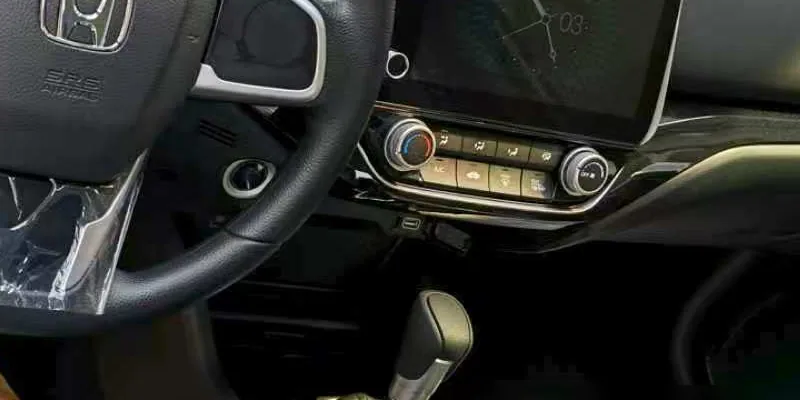
The continuously variable transmission in the Honda Crider, and in most compact Japanese and Chinese sedans, is a durable design when its fluid is right and its temperature is kept in check. Most CVT failures in export markets trace back to one of three causes: fluid left too long, the wrong fluid, or heat from the way the car is used. All three are preventable.
How a belt-type CVT works
Instead of a set of gears, the transmission has two pulleys whose effective diameters change continuously, linked by a steel push belt made of hundreds of thin elements on steel bands. Hydraulic pressure clamps the pulleys onto the belt, and the ratio changes as one pulley opens while the other closes. The engine can therefore stay at its most efficient speed, which is why a small turbo engine and a CVT make an economical pair.
Two consequences follow. First, the transmission depends on friction between steel surfaces, controlled by the fluid; CVT fluid is formulated for that friction behaviour as much as for lubrication and cooling. Second, clamping pressure and heat are closely linked: a CVT worked hard at low speed generates heat that the fluid has to carry away.
Honda's CVTs of this generation also use a control strategy called G-Design Shift, which under hard acceleration lets engine speed rise in steps that feel like gear changes rather than holding it at a constant drone. It is normal behaviour, worth explaining to customers used to conventional automatics.
Fluid: the right one, on time
- Use the specified fluid. The Crider's transmission is specified for Honda's HCF-2 CVT fluid. Conventional automatic transmission fluid is wrong for a CVT, and a "multi-vehicle" CVT fluid is only acceptable if it is explicitly approved for the specification. The wrong friction characteristics show up as judder and slip, sometimes months after the change.
- Follow the interval, and shorten it for severe use. For this gearbox, Chinese service schedules commonly cite a fluid change at around 40,000 km or two years. Heat, heavy traffic, hills, heavy loads and dust are severe conditions, and in many export markets they are the normal ones. For taxi and ride-hailing fleets, a shorter interval is cheap compared with a transmission.
- Know what a fluid change is. A drain and refill replaces only part of the fluid, because much of it stays in the torque converter, cooler and passages. Where fluid has been neglected, several changes spaced over a short distance may be needed to bring it back to condition.
- Keep records. A used CVT car with no fluid history is a price risk, not a detail.
Heat: where CVTs fail in hot countries
A CVT's fluid temperature rises fastest in exactly the situations common in hot, congested cities and hilly regions:
- Long crawls in dense traffic with the air conditioning on and high ambient temperature
- Sustained climbs, especially loaded, and holding the car on a slope with the accelerator instead of the brake
- Towing or carrying loads near the vehicle's limits
- Repeated hard launches from standstill
The transmission protects itself when fluid temperature climbs, typically by limiting engine output and, on many cars, showing a warning. A driver who feels the car lose power on a long hill in summer is seeing that protection. The damage comes from doing it repeatedly: overheated fluid loses its friction properties faster, and a fluid that has cooked is no longer the fluid that was specified.
Keep the cooling system clean. Many CVTs exchange heat with the engine coolant or through a dedicated cooler at the front of the car, and radiators clogged with dust and insects reduce the margin for both engine and transmission.
Driving habits that protect the transmission
- Use the brake, not the accelerator, to hold the car on a slope.
- On long descents, use the lower range positions (S or L on the Crider's selector) for engine braking rather than riding the brakes; on long climbs, the lower range keeps engine speed up and belt load down.
- Come to a complete stop before selecting reverse or drive.
- Do not rock the car out of sand or mud by shifting repeatedly between drive and reverse under power.
- Do not tow beyond the rating in the owner's manual, and do not tow the car itself with its driven wheels on the ground.
Warning signs, and what they usually mean
| Symptom | Common cause | Action |
|---|---|---|
| Judder when pulling away or at light throttle | Degraded or incorrect fluid, early friction problems | Scan for codes, check fluid history, fluid service with the specified fluid |
| Engine speed rises without matching acceleration | Belt slip | Stop hard use and have it diagnosed promptly; continued driving damages pulleys |
| Whine that rises with road speed | Bearing or pulley wear | Diagnosis; compare with a known good car |
| Delay engaging drive or reverse | Low fluid, internal pressure problems | Check level and codes before further use |
| Loss of power on hills or in traffic, warning lamp | Fluid overheating protection | Let it cool; review use and fluid condition |
Buying a used CVT car
- Start the test from cold and drive at least 20 minutes, including a climb and some stop-start traffic.
- Accelerate gently from standstill several times and feel for judder.
- Accelerate firmly at 40–60 km/h and watch that engine speed and road speed rise together.
- Listen for whine with the radio off.
- Scan the transmission module, not only the engine, for stored codes.
- Ask for fluid service records with the fluid specification shown on the invoice.
For dealers importing CVT cars, stock the specified fluid before the first car arrives, and train technicians on the fluid level and fluid service procedure, which on many modern CVTs is done through the diagnostic tool rather than with a dipstick. Our notes on workshop readiness are in technician training and diagnostic tooling, and the engine that drives this gearbox is covered in the Crider 1.0 Turbo engine guide.
Honda, Crider and Honda SENSING are trademarks of Honda Motor Co., Ltd. CZJ Motors is an independent vehicle exporter and is not affiliated with, authorised by or endorsed by Honda Motor Co., Ltd. or GAC Honda Automobile Co., Ltd. The names are used only to identify the genuine vehicles we supply and describe.