
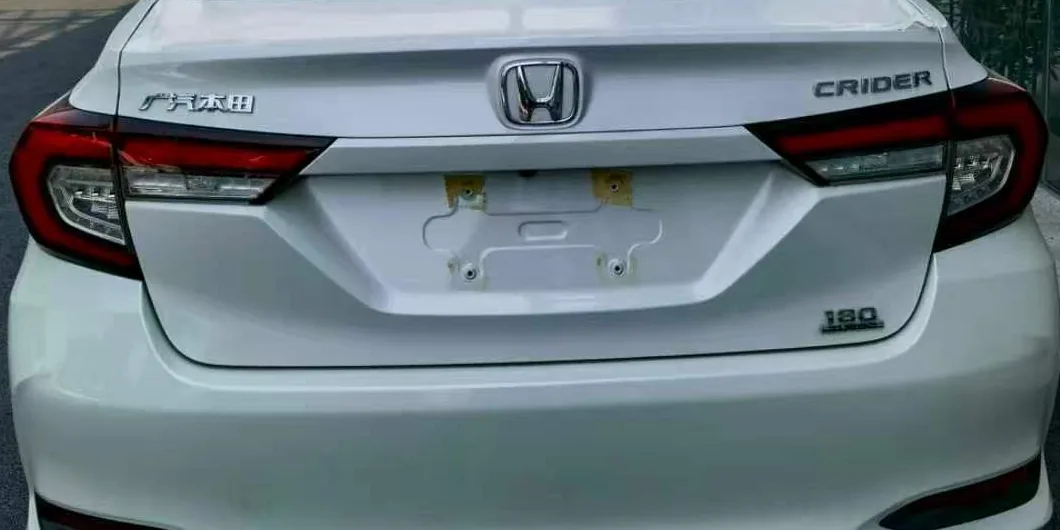
The "180 Turbo" badge on the back of a Crider is Honda's China-market name for a 1.0-litre three-cylinder turbocharged engine. It is an efficient, strong engine for its size, and like every small direct-injection turbo it is less forgiving than the naturally aspirated engines it replaced. Most of what keeps it healthy in export markets comes down to fuel, oil, air and the way the car is used.
The engine in brief
| Family | Honda's 1.0-litre VTEC Turbo, engine type P10A (P10A3 in the Crider) |
|---|---|
| Layout | 988 cc inline three-cylinder, DOHC, four valves per cylinder |
| Fuel system | Direct injection |
| Induction | Single low-inertia turbocharger with an electrically actuated wastegate |
| Valve control | Variable timing on both camshafts and VTEC on the intake side |
| Output | 90 kW (122 PS) at 5,500 rpm; 173 N·m from 2,000 to 4,500 rpm |
| Fuel specified | Unleaded petrol, 92 RON or higher |
| Emission standard | China 6b |
The same engine family, in P10A2 form with identical outputs, powers the City sold in Thailand since 2019, and it was used in the European Civic. That matters for parts and for workshop familiarity in some regions; the Crider buyer guide covers the car as a whole.
Fuel: octane first, then quality
The manufacturer specifies 92 RON or higher. The official China-market petrol Crider manual warns that lower-octane fuel can cause knocking, reduced performance and faults, and that fuel below 89 RON can damage the engine. Knock control is not a reason to use fuel below the specified grade.
- Where the standard grade is below 92 RON, use the next grade up.
- Where fuel is labelled by anti-knock index (AKI, the average of RON and MON), do not convert 92 RON to a fixed AKI value or assume regular-grade petrol meets the requirement. Check the exact vehicle manual and obtain the fuel's RON specification from the supplier, or vehicle-specific guidance from the manufacturer, before choosing a local grade.
- Ethanol. Several Chinese provinces sell only E10 petrol, so China-market cars are built for E10. Higher blends are outside the car's design experience.
- Sulphur and contamination. China 6 petrol is limited to 10 ppm sulphur. Higher-sulphur fuel does not stop the engine, but it reduces catalyst efficiency and accelerates deposits. Buy from high-throughput stations and fit fuel filters on schedule. More on this in fuel quality and engine selection.
Oil: specification matters more than brand
Use the viscosity grade printed in the owner's manual and on the filler area, and an oil that meets current performance standards. The standard matters for a specific reason: small turbocharged direct-injection engines are prone to low-speed pre-ignition, a violent abnormal combustion event under heavy load at low engine speed that can break pistons. The API SP and ILSAC GF-6 oil standards were introduced with protection against it. An older-specification oil, even of the right viscosity, does not provide that protection.
Change oil on time as well as on distance, following the maintenance booklet supplied with the car. Hot, dusty or stop-start operation counts as severe service in any booklet, and the shorter severe-service interval is the one to use in most export markets.
Fuel dilution in cold climates and short trips
Direct injection sprays fuel into the cylinder, and in a cold engine some of it reaches the cylinder walls and passes into the oil. On a long run the engine gets hot enough to evaporate it again. On repeated short trips in cold weather it accumulates, the oil level rises and the oil thins.
This is not theoretical for Honda turbo engines in China. In 2018, following an announcement by the national market regulator, Honda's joint ventures recalled 1.5-litre turbo models after owners in cold northern regions reported rising oil levels; the first recall covered 130,455 vehicles and later recalls took the total above 700,000. That was a different engine from the Crider's 1.0-litre, and it was addressed with software and hardware changes, but the physics apply to every small direct-injection turbo:
- In cold markets, check the oil level regularly. A level that rises above the full mark, or oil that smells of petrol, is a warning.
- Vehicles doing only short urban trips in cold weather should be given a longer run regularly and have oil changed at the severe-service interval.
Air, dust and heat
A turbocharger spins far faster than the engine and is the first component to suffer from dust that gets past the air filter. In dusty markets, inspect the air filter at every service and replace it more often than the booklet's normal interval; check the intake ducting for cracks and loose clamps, because unfiltered air entering after the filter goes straight to the compressor wheel.
Heat is the other enemy. Modern turbochargers with water-cooled bearings do not need the long idling cool-downs once recommended for older designs, but after sustained hard driving in high ambient temperatures, a short period of gentle driving before switching off is still good practice. Keep the cooling system to specification, and do not let radiators clog with dust or insects.
Deposits on intake valves
In a port-injected engine, fuel washes the back of the intake valves. In a direct-injection engine it does not, and oil vapour from the crankcase ventilation system can bake onto the valves over high mileage. The symptoms are gradual: rough idle, hesitation and misfires, usually far into the car's life. Good oil, regular changes and occasional sustained driving slow the build-up; removal, where needed, is a workshop job on the intake side and not something a fuel additive fixes.
Three cylinders: what is normal
A three-cylinder engine has a different firing rhythm from a four, and at idle it transmits a slightly more noticeable pulse. Engine mounts are tuned to absorb it. What is normal is a steady, even idle; what is not is a shake that varies or grows, which points to a misfire, a worn mount or deposits. Customers new to three-cylinder engines sometimes report the normal character as a fault, so it is worth explaining at handover.
A service checklist for dealers
- Oil to the manual's viscosity and to API SP or ILSAC GF-6 or later, changed on time and distance
- Air filter inspected every service, replaced early in dusty conditions
- Oil level checked at every visit in cold markets
- Correct octane explained to the customer at delivery, in writing
- Spark plugs at the booklet interval
- Diagnostic scan at every service to catch misfire counts and fuel trim trends early
These cars are available now from our stock: Honda Crider 180 Turbo CVT.
Sources for fuel-grade requirements
- Official 2024 petrol Crider owner manual, fuel recommendation section
- EIA explanation of RON, MON and pump octane
Honda, Crider and Honda SENSING are trademarks of Honda Motor Co., Ltd. CZJ Motors is an independent vehicle exporter and is not affiliated with, authorised by or endorsed by Honda Motor Co., Ltd. or GAC Honda Automobile Co., Ltd. The names are used only to identify the genuine vehicles we supply and describe.