
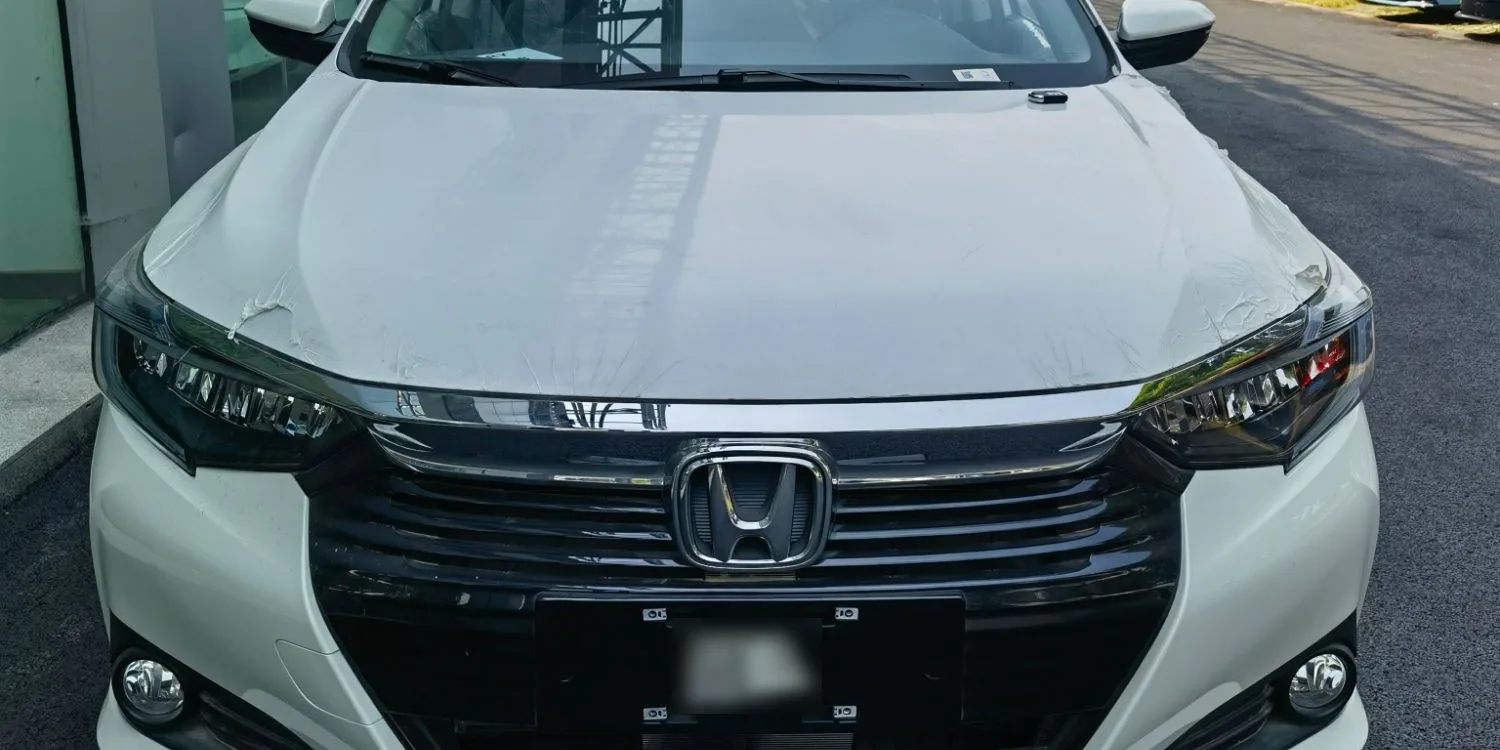
For several years, a large share of the "new" Chinese cars sold abroad were technically used: registered in China for a few days, transferred for export and shipped with next to nothing on the odometer. From 1 January 2026 that route changed. This is what the rule says, why it was introduced and how to read an offer of a "brand new" car from China today.
1. What a zero-kilometre used car is
A zero-kilometre used car is a vehicle that has completed registration in China but has not really been used: the odometer shows a handful of kilometres, the protective film is still on the seats, and the only thing that makes it "used" is the registration record. Legally it is a second-hand vehicle. Commercially it is sold as new.
The scale was not marginal. According to figures from the China Automobile Dealers Association cited in Chinese press coverage of the new rule, vehicles registered for three months or less with 50 km or less on the clock made up 12.7% of China's used-car market in 2024, roughly one transaction in eight.
2. Why the route existed
China licenses every vehicle export. For new vehicles, the licence goes to manufacturers and to export companies they authorise, and the authorities publish the list of qualifying enterprises each year. A trader without a manufacturer's authorisation cannot export a new car in its own name.
The used-vehicle export channel, opened to pilot enterprises from 2019 and widened since, has different qualification rules. Registering a new car and then exporting it as used turned a vehicle the trader could not export into one it could. Price did the rest: a domestic market in a prolonged price war produced dealer stock that sold at a discount, and that discount travelled abroad.
The costs landed elsewhere. Manufacturers saw their own products undercut in markets where they were building dealer networks, and buyers received cars with no manufacturer after-sales support in their country. The notice that restricted the practice addresses both.
3. What the 2026 rule requires
In November 2025, four ministries (Commerce; Industry and Information Technology; Public Security; and the General Administration of Customs) issued a joint notice on strengthening the management of used-vehicle exports, reference Shang Mao Han [2025] No. 648. Its central provisions:
| In force from | 1 January 2026 |
|---|---|
| Vehicles covered | Vehicles applying for export under the used-vehicle route within 180 days (inclusive) of their registration date |
| What is required | An after-sales maintenance service confirmation issued by the vehicle's manufacturer and bearing its seal |
| What it must state | The destination country, the vehicle's details including the VIN, and the overseas after-sales service outlet |
| Without it | No export licence is issued |
| Licence annex | The registration date and the date of transfer registration for export must be entered on every licence |
| Transition | The notice provides for orderly export of vehicles whose transfer registration for export was completed before the notice took effect. Confirm eligibility with the licensing authority; do not assume every transfer before 1 January 2026 qualifies. |
The notice also tightens checks on modified vehicles, requires the declared vehicle information to match the registration certificate, and sets up credit records and exit procedures for exporters that repeatedly break the rules or fail to support vehicles they have sold.
4. What a "brand new" offer can mean now
Put together, the rules leave three legitimate ways for a new or nearly new car to leave China:
- As a new vehicle, exported by the manufacturer or an exporter it has authorised. The car has never been registered and travels with its factory certificate.
- As a used vehicle registered more than 180 days before the export licence application. Low mileage does not change its used-vehicle registration status. The additional manufacturer confirmation triggered by this notice's 180-day threshold does not apply, but the normal export licence and destination import requirements still do.
- As a used vehicle registered within 180 days (including day 180) at the export licence application, with the manufacturer's confirmation. The vehicle manufacturer must issue and seal the after-sales maintenance service confirmation, identifying the destination country, vehicle and overseas service outlet. Without that confirmation, the export licence is not issued.
An offer that fits none of these, such as a car registered last month and offered by a trader with no connection to the brand, raises an obvious question: how will it obtain an export licence? Ask it before you pay, not after.
5. What it means in your country
A car exported under the used-vehicle route is documented as used, whatever its odometer says. In your country that can matter more than the price:
- Used-vehicle import rules may apply. Some markets limit the age of used vehicles they admit, some apply different duty or inspection regimes to them, and some do not admit them at all. The relevant date is usually the first registration date, not the build date or the mileage.
- Registration may treat it as second-hand. Your customer may become the second registered owner, with an effect on resale value.
- Manufacturer support is not transferred. Warranty and recall handling follow the manufacturer's own distribution channels. A car exported outside them depends on the exporter and the local workshop.
Check the classification with your customs broker using the actual registration date before you commit. If your market has homologation requirements, they apply to new and used imports alike: homologation and type approval.
6. Documents to ask for, by route
| Route | Key documents | What to check |
|---|---|---|
| New vehicle | Factory certificate of the vehicle, export licence held by the exporter, commercial invoice, bill of lading | The exporter on the licence is the company you are paying; the VIN matches on every document |
| Used, registered over 180 days | Registration certificate details, record of transfer for export, export licence with registration dates in the annex, commercial invoice, bill of lading | Registration date against your country's used-import rules; VIN and engine number on every document |
| Used, registered 180 days or less | As above, plus the manufacturer's sealed after-sales service confirmation naming your country and a service outlet | That the confirmation names your country, your VIN and a real service outlet |
The full shipping document set is in our vehicle export documentation checklist, and the reasons a single transposed digit stops registration are covered in VIN and engine number matching.
7. Red flags
- A price well below that of genuinely new stock, with no explanation of the export route
- A seller who cannot say whether the car has been registered in China, or when
- A registration date within the last six months and no mention of the manufacturer's confirmation
- Documents or an export licence in the name of a company other than the one you are paying
- Reluctance to put the route, the registration date and the document list in the contract
Our own practice follows from this: for every unit we offer, including the Honda Crider 180 Turbo sedans now in stock, we state the route, the registration date if any and the document list in writing before a deposit is paid.
8. Frequently asked questions
Is a zero-kilometre used car illegal?
No. Registering a car and later exporting it through a qualified used-vehicle exporter is legal. What changed in 2026 is that doing so within 180 days of registration now requires the manufacturer's after-sales confirmation.
Does the rule apply to electric cars?
The 180-day rule applies to used-vehicle exports of any powertrain. Separately, since 1 January 2026 China has also applied export licence management to pure electric passenger cars.
Will my customs office see the registration date?
The registration date and the transfer-for-export date are entered on the Chinese export licence. Whether your customs office asks for it depends on your country; assume the history is discoverable and price the car accordingly.
Is a car registered more than 180 days ago a bad buy?
Not necessarily. It can be a sound car at a fair price, provided you treat it as what it is: a used vehicle with a known registration date, a real build date that is older still, and no manufacturer support in your market.
Honda, Crider and Honda SENSING are trademarks of Honda Motor Co., Ltd. CZJ Motors is an independent vehicle exporter and is not affiliated with, authorised by or endorsed by Honda Motor Co., Ltd. or GAC Honda Automobile Co., Ltd. The names are used only to identify the genuine vehicles we supply and describe.